


Table of Contents
D-mannose comes with a clever story: a simple sugar that gives bacteria something to grab besides your bladder. The catch is that not every germ plays by the same rules, which limits D-mannose benefits.
D-mannose was mainly studied against E. coli, which clings to the bladder wall with sticky, hair-like strands. Other bacteria attach in different ways. Even for E. coli, the largest trial found D-mannose no better than a placebo for repeat urinary tract infections (UTIs). If symptoms are happening now, call a doctor. At Alerna Kidney Health, we think a good story deserves an honest fact check.
THE HONEST WAY TO ADD D-MANNOSE
Wondering what D-mannose can and can't do? Keep reading for the honest answer. If you want it in your daily routine, Alerna's D-Mannose pairs it with cranberry concentrate and vitamin C to support normal urinary tract function. It's one part of a proactive, long-term wellness routine, not a replacement for your doctor.
See the Formula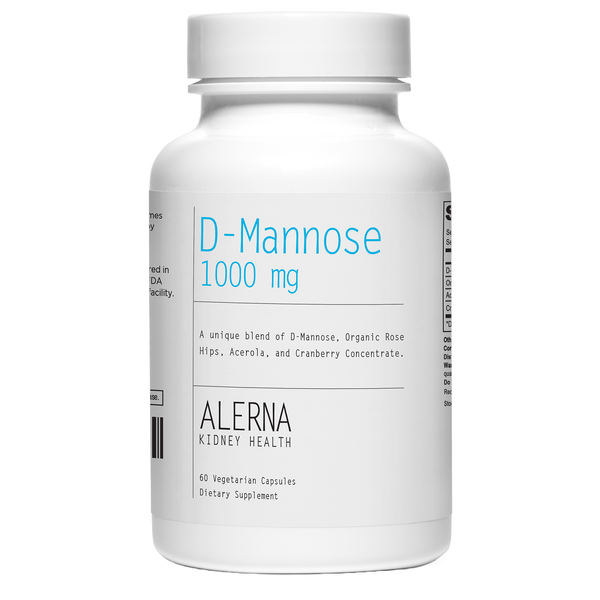
What Is D-Mannose?
D-mannose is a natural sugar found in small amounts in food, especially fruits like apples, oranges, and peaches. What makes it interesting is where it ends up in the body.
A Simple Sugar Related to Glucose
D-mannose has almost the same structure as glucose, the sugar your cells burn for energy, but only a small share of it gets metabolized. A review in Frontiers in Pharmacology reports that most of it is absorbed in the upper intestine with no meaningful rise in blood sugar. Supplement sellers often say it's absorbed eight to 10 times slower than glucose, though those exact figures trace back to marketing more than to clear human data.
Largely Passed into Urine
D-mannose has good bioavailability, meaning most of what you swallow gets absorbed, and a large share then leaves the body unchanged in urine within hours. That's why researchers first looked at it for the urinary tract. Supplements come as powder, capsules, or tablets. In capsules, D-mannose is the active ingredient inside a plant-based or gelatin capsule shell.

What Causes Urinary Tract Infections?
Urinary tract infections happen when bacteria get into the urinary tract and multiply. Most infections start in the lower urinary tract, when germs from the skin near the anus travel up the urethra into the bladder. That can cause a bladder infection called cystitis, which brings inflammation, pain, and pressure.
If bacteria keep climbing through the ureters to the kidneys, the infection becomes pyelonephritis, which is more serious. Catheters, recent surgery on the urinary tract, kidney stones, and pregnancy all raise the risk.
Several kinds of bacteria cause these infections, and they don't all hang on the same way:
E. coli: behind about 80% of UTIs. It uses hair-like strands tipped with a protein called FimH, which latches onto mannose on bladder cells.
Staphylococcus saprophyticus: about 10% to 15% of cases, mostly in young women. It doesn't use FimH.
Klebsiella and Enterobacter: these carry similar mannose-binding strands.
Proteus: relies mainly on strands that don't bind mannose.
Enterococcus: attaches through other surface proteins.

Why Does the Type of Bacteria Matter?
The whole case for D-mannose rests on one specific grip, and that grip shows up in only some bacteria. Your kidneys already use a version of the same trick.
Built around E. coli's Grip
In lab and animal research, free D-mannose in urine can coat FimH, so the bacteria get flushed out instead of sticking to bladder cells. The body has a similar built-in defense. The kidneys make a mannose-rich protein called uromodulin, one of several natural substances secreted into urine that can bind these same bacteria. How well added D-mannose works in people is a separate question.
A Poor Match for Other Bacteria
Bacteria that don't use FimH give the theory nothing to work with. A UTI caused by Staphylococcus saprophyticus or Enterococcus, for example, gives D-mannose no clear target.
Not Even Every E. coli Strain
Some E. coli strains use different strands, called P fimbriae, that don't bind mannose. These strains are often linked to kidney infections, the kind that matters most for long-term kidney health.
A SIMPLE SUGAR IN A SIMPLE CAPSULE
Now you know what D-mannose is: a simple sugar your body absorbs well and largely passes into urine. Alerna's D-Mannose puts it in vegetarian capsules with cranberry concentrate and vitamin C from organic rose hips. It's vegan, made in the USA in a cGMP-compliant facility, and easy to fit into a daily routine that supports normal urinary tract function.
Shop D-MannoseWhat Do Human Studies Show about D-Mannose Benefits?
Results from human studies shifted once researchers started comparing D-mannose with a placebo. The science looked strong at first, and then the most careful trial told a different story.
Promising Early Results
A 2013 trial of about 300 women with recurrent UTI found repeat infections in 14.6% of the D-mannose group, 20.4% of the antibiotic group, and 60.8% of those with no preventive treatment. The trial had no placebo and wasn't blinded, so the women knew what they were taking.
No Edge over Placebo in 2024
A 2024 article in JAMA Internal Medicine, a journal published by the American Medical Association, reported on 598 women with recurrent UTI. Each took a daily dosage of 2 grams of D-mannose or a placebo for six months, the largest test of D-mannose for UTI prevention to date.
Repeat UTIs occurred in 51.0% of the D-mannose group and 55.7% of the placebo group, which is no meaningful difference. Symptom days and antibiotic use were similar, too.
Not a Treatment for Active Infections
D-mannose doesn't treat an active infection, and it hasn't proven to be an effective alternative to antibiotics. Concern about antibiotic resistance leads many people to look for natural remedies. Skipping antibiotics for a real infection, though, can turn a bladder problem into a real disaster if it reaches the kidneys. Anyone with symptoms needs proper treatment, even those who already take D-mannose every day.

How Can You Keep Your Urinary Tract Healthy?
A few everyday habits support urinary tract health, and some have solid research behind them:
Drink enough water: in a 2018 trial, women who normally drank little water added about 1.5 liters a day and had fewer bladder infections.
Don't hold it: go when you feel the urge.
Urinate after sex: this is common advice after sexual intercourse, though the research is limited.
Skip spermicides: spermicide use is linked to higher UTI risk.
Ask about options after menopause: doctors often suggest vaginal estrogen for patients with recurrent UTIs.
Treat probiotics as unproven: they're being studied for urinary tract health, but the evidence is still early.
Know the warning signs: fever, back or side pain, nausea, or blood in the urine need prompt care, as do symptoms that won't let up.
KNOW YOUR BACTERIA. OWN YOUR ROUTINE.
You know the plan: ask for a urine culture at your next UTI, drink enough water, and see your doctor if infections keep coming back. Then build your daily routine around habits you can keep. If D-mannose fits, Alerna's D-Mannose with cranberry concentrate and vitamin C supports normal urinary tract function. Talk with your doctor first, then make it part of your day.
Start My Daily RoutineWhich Bacteria Caused Yours?
D-mannose was built around one type of grip, mostly found in E. coli, and even there the best trial found no edge over placebo. There's no single solution for recurrent UTI, so if your infections keep coming back or start to feel chronic, ask your doctor for a full checkup.
If you want D-mannose as part of a daily routine, Alerna Kidney Health's D-Mannose comes combined with cranberry concentrate and vitamin C to support normal urinary tract function. It isn't a UTI treatment, so talk with your doctor first, especially if you have allergies or take other medications. At your next UTI, ask for a urine culture and the name of the bacteria. That one answer tells you more than any supplement label.
These statements have not been evaluated by the Food and Drug Administration. This product is not intended to diagnose, treat, cure, or prevent any disease.
Frequently Asked Questions
What are the benefits of D-mannose?
Research on D-mannose benefits has focused on the urinary tract, where lab studies show it binds to E. coli's FimH, but the largest human trial found no benefit over placebo for repeat UTIs.
Does D-mannose work for E. coli UTIs?
E. coli is the bacterium the theory was built around, yet the 2024 trial, in a group where most UTIs involve E. coli, found no drop in repeat infections.
Can D-mannose cure a UTI?
It isn't a treatment for an active infection, so see a doctor, since an untreated UTI can reach the kidneys.
Is it safe to take D-mannose every day?
D-mannose has a good safety record in short trials, with mostly mild side effects like loose stools or bloating, but ask a doctor first if you're pregnant, have diabetes, kidney disease, or liver disease, or plan to give it to children.
Can men take D-mannose?
Men can take it, though most research involved women, and UTIs in men are less common and usually need a medical checkup to find the cause.
Medical Disclaimer:
The information provided in this article is for educational and informational purposes only and should not be considered a substitute for professional medical advice, diagnosis, or treatment. Please consult with your healthcare provider before starting any new dietary supplement, especially if you are pregnant, nursing, have a medical condition, or are taking other medications. Never disregard professional medical advice or delay in seeking it because of something you have read in this article.
References
Ala-Jaakkola, R., Laitila, A., Ouwehand, A. C., & Lehtoranta, L. (2022). Role of D-mannose in urinary tract infections - a narrative review. Nutrition journal, 21(1), 18. https://doi.org/10.1186/s12937-022-00769-x
Belyayeva, M., Leslie, S. W., Rout, P., & Jeong, J. M. (2024). Acute Pyelonephritis. In StatPearls. StatPearls Publishing. https://pubmed.ncbi.nlm.nih.gov/30137822/
Cheng, M., Ren, L., Jia, X., Wang, J., & Cong, B. (2024). Understanding the action mechanisms of metformin in the gastrointestinal tract. Frontiers in pharmacology, 15, 1347047. https://doi.org/10.3389/fphar.2024.1347047
Hayward, G., Mort, S., Hay, A. D., Moore, M., Thomas, N. P. B., Cook, J., Robinson, J., Williams, N., Maeder, N., Edeson, R., Franssen, M., Grabey, J., Glogowska, M., Yang, Y., Allen, J., & Butler, C. C. (2024). d-Mannose for Prevention of Recurrent Urinary Tract Infection Among Women: A Randomized Clinical Trial. JAMA internal medicine, 184(6), 619–628. https://doi.org/10.1001/jamainternmed.2024.0264
Kranjčec, B., Papeš, D., & Altarac, S. (2014). D-mannose powder for prophylaxis of recurrent urinary tract infections in women: a randomized clinical trial. World journal of urology, 32(1), 79–84. https://doi.org/10.1007/s00345-013-1091-6


