


Table of Contents
QUICK ANSWER
There's no official limit on cherries for gout, since they're low in purines and fit most gout-friendly diets. In the largest study, eating about 15 to 18 cherries a day over two days was linked to fewer gout attacks, and eating more added no benefit. Controlled trials haven't confirmed that link, so cherries can't replace gout medication. Watch the sugar, especially in cherry juice.
Ask a few people with gout about cherries, and at least one will swear by them. The research on cherries and gout is more careful than the gossip.
There's no official limit on cherries, and they're low in purines. In the largest study, eating about 15 to 18 cherries a day over two days was linked to fewer gout attacks, and eating more added no benefit. Controlled trials haven't confirmed that link. At Alerna Kidney Health, we'd rather share the real research than a miracle story. Cherries can fit a gout-friendly diet, but they can't replace medical treatment.
TART CHERRY WITHOUT THE HYPE
Wondering how many cherries fit into your day? Keep reading for what the research really shows. If you want an easy way to enjoy tart cherry every day, Alerna's Tart Cherry puts tart cherry extract in a vegetarian capsule. No miracle promises. Just plant-based antioxidant support for a proactive, long-term wellness routine.
Explore Tart Cherry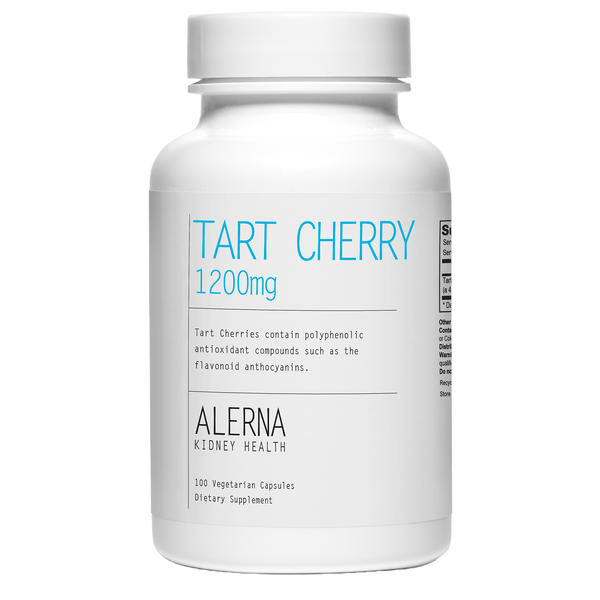
What's the Link between Cherries and Gout?
Gout is a form of arthritis, and cherries entered the picture through a mix of folk wisdom and lab science. The story starts in the joints and ends with a red pigment.
Uric Acid at the Root
When uric acid builds up in the blood, it can form sharp crystals in a joint. The body treats those uric acid crystals as a threat, and the resulting inflammation makes a gout attack sudden and painful. Over time, crystals can also collect under the skin as hard bumps called tophi.
Purines from foods like red meat and some seafood raise uric acid levels, and so does alcohol. Other risk factors include obesity, high blood pressure, diabetes, and kidneys that don't clear uric acid well.
Plant Pigments Called Anthocyanins
The red and purple color of cherries comes from anthocyanins, plant pigments that researchers have studied for antioxidant activity. Cherries also provide some vitamin C and fiber.
In a small 2003 study, 10 healthy women ate about 45 sweet cherries, and blood urate dropped about 15% within five hours. These were healthy volunteers, not gout patients, so the result doesn't show what happens in people already diagnosed with gout.

Can Eating Cherries Prevent Gout Attacks?
Research says maybe, and honestly, not on its own. The answer shifts depending on how each study was designed.
Promising Observational Research
The best-known evidence comes from a 2012 article in Arthritis & Rheumatism. Researchers followed 633 people diagnosed with gout and compared the two days before an attack with two-day periods when no attack happened.
Researchers found that eating cherries during a two-day window was linked to a 35% lower risk of gout attacks. Participants who ate cherries and also took allopurinol, a medication that lowers uric acid, had a 75% lower risk. This type of study shows a link, not cause and effect. People who eat more fruit may also make other choices that affect the incidence of attacks.
Mixed Results in Controlled Trials
Controlled trials, the kind that can show cause and effect, have been less encouraging. A 2020 trial gave 50 gout patients tart cherry concentrate for 28 days and found no change in uric acid or flares.
A 12-month UK trial with 38 people compared daily tart cherry juice with a placebo. The results, published in a 2022 thesis, showed no benefit for flares, uric acid, or inflammatory markers. Both trials were small, so neither settles the question. A 2019 review of six studies found a link but too little data to combine the results.
No Replacement for Gout Treatment
Experts writing alongside the 2012 study cautioned against dropping standard therapy. Medication is still the first line of treatment, and cherries won't rid the joints of uric acid crystals. If you add cherries to your diet, stick with your prescribed medicine and let your doctor know.
SKIP THE JUICE SUGAR. KEEP THE TART CHERRY.
You just saw the trade-off. A cup of sweet cherries has about 18 to 20 grams of sugar, and big portions can upset your stomach. Alerna's Tart Cherry gives you tart cherry extract in a vegetarian capsule, with no juice to measure and no bowl to finish. It's an easy way to keep plant-based antioxidant support in your daily routine.
Try Tart Cherry CapsulesHow Many Cherries a Day?
Research gives a useful range, but diet, medication, and a doctor's advice still matter more than any single number. The sugar in cherries also deserves a look.
No Official Limit for Gout
There's no official daily cherry limit for gout. Cherries are low in purines and fit most gout-friendly eating plans, and more fruit is a good thing for most people.
Roughly 15 to 18 a Day in Research
The 2012 study defined one serving as half a cup, or about 10 to 12 cherries. The lower risk leveled off at three servings over two days, and eating more didn't add benefit. That works out to about 30 to 36 cherries over two days, or roughly 15 to 18 a day. Keep in mind that this number comes from observational data, not a controlled trial.
The Sugar Trade-Off
A cup of pitted sweet cherries has about 18 to 20 grams of sugar, including fructose. Fructose raises uric acid production in the body, and sugary drinks are linked to a higher risk of gout. On the other hand, tart cherries have less sugar. Large portions also increase the sugar load and can upset the stomach, since cherries contain sorbitol and fiber.

What's the Smartest Way to Eat Cherries?
A few easy habits help cherries fit a gout-friendly routine:
Go whole: choose fresh or frozen cherries over sweetened juice or pie filling.
Read juice labels: even 100% cherry juice, a popular drink for gout, has about 25 to 30 grams of sugar per cup.
Try tart cherries: they're a lower-sugar pick for anyone watching sugar.
Spread them out: a handful at a time is easier on the stomach than a big bowl.
Mind the bigger picture: cutting back on alcohol and sugary drinks, and reaching a healthy weight, are more likely to improve uric acid levels than any single fruit.
Keep your plan: stay on any prescribed gout medication, even on days you feel fine.
Ask first: talk to a doctor before taking cherry juice or cherry extract supplements, especially with kidney concerns or other medications.
YOUR DAILY TART CHERRY ROUTINE STARTS HERE
You know the research, the sugar to watch, and why your treatment plan still comes first. Here's your next step: ask your doctor about tart cherry, then add Alerna's Tart Cherry to your day. Tart cherry extract in a vegetarian capsule for plant-based antioxidant support, with no juice or measuring required. Simple, steady, and yours.
Start My Tart Cherry RoutineWhy Not Start with a Handful?
There's no official limit on eating cherries, and research points to about 15 to 18 a day, but the trials are mixed, and medical treatment still comes first. Treat cherries as a healthy part of your diet, not a fix for gout. Some people prefer tart cherry in capsule form.
Alerna Kidney Health's Tart Cherry offers tart cherry extract for plant-based antioxidant support in a vegetarian capsule. It isn't a gout treatment, so check with your doctor first. Grab a bag of fresh or frozen cherries this week, and bring your questions to your next doctor visit.
These statements have not been evaluated by the Food and Drug Administration. This product is not intended to diagnose, treat, cure, or prevent any disease.
Frequently Asked Questions
Are cherries good for gout?
Cherries fit well in a gout-friendly diet because they're low in purines, and one large observational study linked them to fewer gout attacks, though small controlled trials haven't confirmed it.
Is cherry juice good for gout?
Results are mixed, since two small controlled trials of tart cherry juice found no clear effect on uric acid or flares, and a cup of juice has about 25 to 30 grams of sugar.
Do cherries lower uric acid?
A small study in healthy women found a short-term drop after eating about 45 cherries, but a trial in people with gout found no change with tart cherry concentrate.
Are tart cherries or sweet cherries better for gout?
No clear evidence favors one type, since the 2012 study didn't compare cherry types, but tart cherries have less sugar.
What fruits should you avoid with gout?
Most whole fruits fit a gout-friendly diet, and the bigger concern is fructose-sweetened drinks and large amounts of fruit juice, which are linked to higher uric acid.
Medical Disclaimer:
The information provided in this article is for educational and informational purposes only and should not be considered a substitute for professional medical advice, diagnosis, or treatment. Please consult with your healthcare provider before starting any new dietary supplement, especially if you are pregnant, nursing, have a medical condition, or are taking other medications. Never disregard professional medical advice or delay in seeking it because of something you have read in this article.
References
Chen, P. E., Liu, C. Y., Chien, W. H., Chien, C. W., & Tung, T. H. (2019). Effectiveness of cherries in reducing uric acid and gout: A systematic review. Evidence-Based Complementary and Alternative Medicine, 2019, Article 9896757. https://doi.org/10.1155/2019/9896757
Jacob, R. A., Spinozzi, G. M., Simon, V. A., Kelley, D. S., Prior, R. L., Hess-Pierce, B., & Kader, A. A. (2003). Consumption of cherries lowers plasma urate in healthy women. The Journal of Nutrition, 133(6), 1826–1829. https://doi.org/10.1093/jn/133.6.1826
Lamb, K. L., Lynn, A., Russell, J., & Barker, M. E. (2020). Effect of tart cherry juice on risk of gout attacks: Protocol for a randomised controlled trial. BMJ Open, 10(3), Article e035108. https://doi.org/10.1136/bmjopen-2019-035108
Stamp, L. K., Chapman, P., Frampton, C., Duffull, S. B., Drake, J., Zhang, Y., & Neogi, T. (2020). Lack of effect of tart cherry concentrate dose on serum urate in people with gout. Rheumatology, 59(9), 2374–2380. https://doi.org/10.1093/rheumatology/kez606
Zhang, Y., Neogi, T., Chen, C., Chaisson, C., Hunter, D. J., & Choi, H. K. (2012). Cherry consumption and decreased risk of recurrent gout attacks. Arthritis & Rheumatism, 64(12), 4004–4011. https://doi.org/10.1002/art.34677


